 PURSUE · NASA · APOLLO 12
VIEW IN UMBRA — the full lunar plate in the app
PURSUE · NASA · APOLLO 12
VIEW IN UMBRA — the full lunar plate in the app
THE APOLLO OBSERVATIONS
The Apollo record is the densest seam in NASA's UAP file, and Umbra indexes it mission by mission. In the Apollo 11 Technical Crew Debriefing of July 1969, Buzz Aldrin describes an object sighted roughly "1 day out" and "close to the moon" — something of "sizeable dimension" the crew cautiously guessed might be their own discarded S-IVB stage. The same debrief logs little flashes of light inside the cabin and one bright light tentatively ascribed to "a possible laser."
Apollo 12 carried the thread forward in November 1969. The Air-to-Ground Voice Transcription captures Alan Bean watching particles and flashes "sailing off in space" through the Alignment Optical Telescope, while Pete Conrad reported illuminated debris drifting outside the module. A separate medical debriefing records Conrad, Gordon and Bean seeing "streaks of light" as they tried to sleep — later assessed as internal to the astronauts' vision, the retinal signature of cosmic rays.
By Apollo 17 in December 1972, the sightings had become a chorus. Across the Crew Debriefing, the Air-to-Ground transcription and the science debrief, Cernan, Schmitt and Evans describe "very bright particles," tumbling lights they likened to "the Fourth of July," intense flashing, and a flash on the lunar surface north of Grimaldi crater. A NASA photograph from the same mission shows three dots in a triangular formation in the lunar sky — an image so striking that, under PURSUE, the Department of War opened a case, obtained the original film, and left the analysis pending.
GEMINI 7 — THE "BOGEY"
In 1965, Frank Borman and Jim Lovell flew Gemini 7, and the transcript Umbra indexes reads like a cold-war intercept report. Borman called out a "bogey" — the contemporary term for an unidentified aircraft — alongside a debris field of "hundreds of little particles" trailing some four miles out. Lovell, for his part, described "a brilliant body in the sun against a black background with trillions of particles." The file's handwritten margin notes are annotated, plainly, "UFO Sighting by Borman."
PROJECT MERCURY — THE FIREFLIES
The earliest entries belong to Project Mercury, where the phenomenon got its enduring name. On MA-6, John Glenn watched luminous "fireflies" stream past his capsule; on MA-7, Scott Carpenter logged white particles that "look exactly like snowflakes"; on MA-8, Wally Schirra described "little white objects" he compared to "lathe shavings"; and on MA-9, Gordon Cooper saw the fireflies again. NASA would later attribute most of it to frozen condensation, ice and stray mission equipment — but the raw observations, in the astronauts' own words, are preserved in the catalog.
SKYLAB & THE LUNAR PHOTOGRAPHS
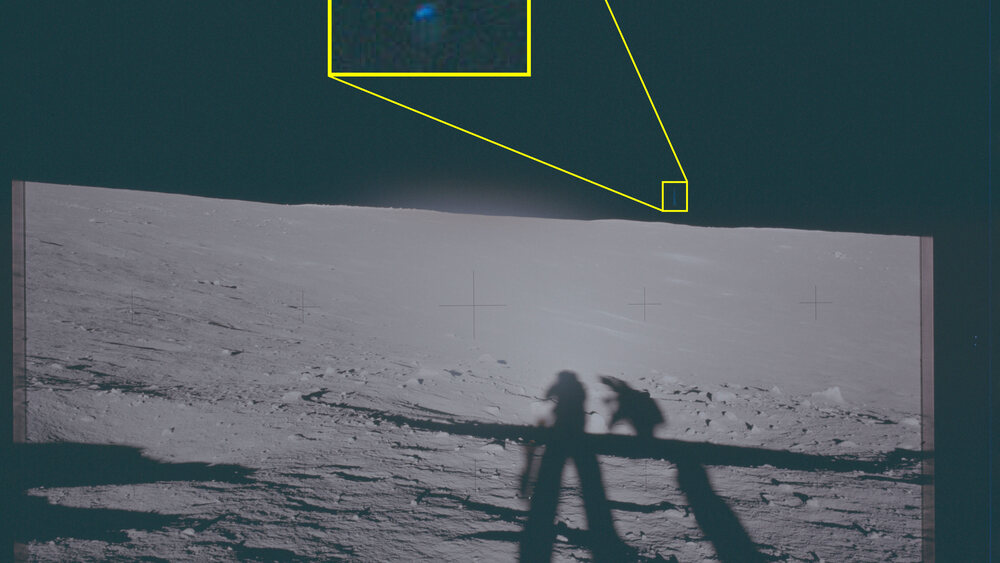
Skylab's three crews each logged light flashes during their 1973–74 missions, and the Skylab 3 crew tracked a bright reddish object — "much brighter than Jupiter" — for five to ten minutes before it was assessed as a satellite sharing a similar orbit. Rounding out the visual record, Umbra surfaces the lunar-surface photography set NASA-UAP-VM1-6: Apollo 12 and Apollo 17 frames with the UAP regions highlighted, so you can study the anomalies the way the case files do.
Roughly two dozen NASA artifacts sit in the app — debriefs, air-to-ground transcripts, science reports and photographs — every one of them drawn from the public PURSUE record. Download Umbra to read the astronauts' accounts in full, in their own voice, on your own screen.
- NASA-UAP-DApollo 11 Technical Crew Debriefing — Aldrin's object, the cabin flashes and the "possible laser."
- NASA-UAPApollo 12 Air-to-Ground Voice Transcription — Bean's optical-telescope particles, Conrad's drifting debris.
- NASA-UAP-D3Gemini 7 transcript — Borman calls out a "bogey" and a four-mile debris field.
- NASA-UAPApollo 17 Crew Debriefing — Cernan, Schmitt and Evans on bright particles and tumbling flashes.
- NASA-UAPMercury-Atlas 9 — Gordon Cooper's "fireflies" outside the capsule.
- NASA-UAP-VM1-6Apollo 12 & 17 lunar-surface photographs with the UAP regions highlighted.
> Read NASA's UAP record natively — transcripts, debriefs and lunar photos, exactly as the astronauts logged them.